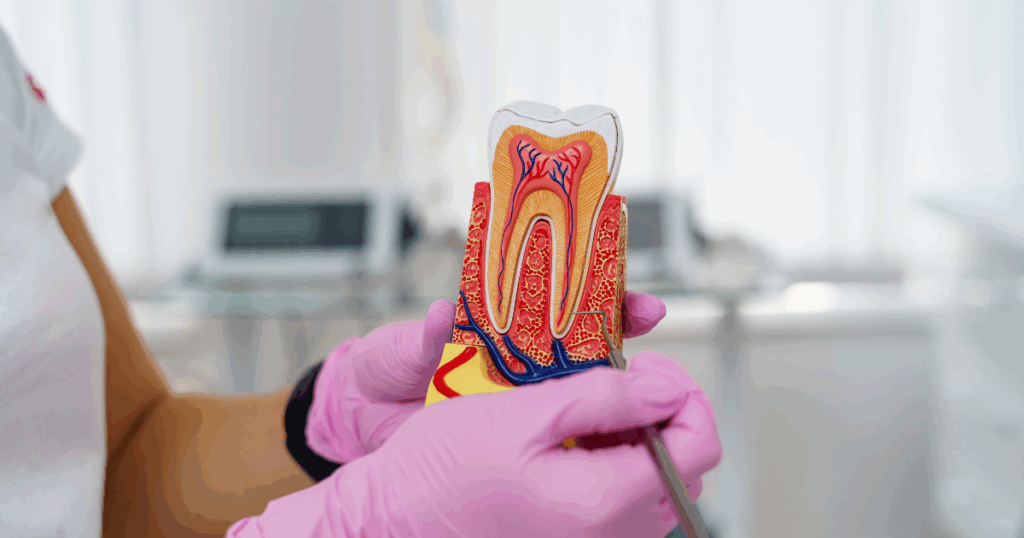
Root Canal treatment is a dental treatment done when you feel something sharp jolt deep inside your tooth like a signal flare that something’s very wrong. That pain often means the inner soft tissue of the pulp is infected. And that’s where a Root Canal Treatment steps in: it saves your natural tooth by gently removing the infected pulp, cleaning the inner canals, sealing them, and restoring the tooth so it feels and works like normal again.
In modern dentistry, a Root Canal is less scary than its reputation. It’s a common, reliable procedure, shown to be effective in 86–98 % of cases, according to studies in the European Journal of Dentistry and Delta Dental. Patients who get one can often keep that tooth for decades and sometimes for life if they follow proper Root Canal Treatment care afterward.
Here’s how it works: your dentist or an endodontist numbs the area, passes tiny instruments into your tooth, removes the damaged pulp, disinfects the root canal space, then seals it usually with a material called gutta percha. Finally, a crown or filling helps protect and restore the chewing function.
But when do you need one? Watch for symptoms like lingering tooth sensitivity to hot or cold, throbbing pain when chewing, a darkened tooth, a small bump on the gums, or swelling in your jaw. These signs usually mean the infection has spread into the pulp and needs attention and fast.
A well executed Root Canal Treatment not only removes your pain it stops infection from spreading, prevents tooth loss, and helps you avoid more complex treatments like implants. At Gravity Dental Polyclinic, we’re here to guide you through how it works, why it’s often a better option than extracting the tooth, and what to expect during recovery from local anesthesia to gentle aftercare.
What Are the Steps in Root Canal Treatment?
A Root Canal is a procedure that removes infected nerve tissue inside your tooth to save it and stop pain. Here’s what to expect when you come in for Root Canal Treatment:
1. Evaluation and X‑Rays
Your dentist starts with a clinical exam and X-rays to see the size of infection and root anatomy. This helps plan whether you’ll need one or more visits and confirms exactly where the infection is located.
2. Local Anesthetic & Isolation
Your tooth is numbed with anesthesia. Sometimes, if the nerve is already dead, you might feel no pain even without it. A small rubber sheet called a dental dam is placed to isolate the area and keep saliva away during the procedure.
3. Access and Removal
A tiny hole is created in the crown of your tooth. Special tools remove the infected pulp from the root canals. Any abscess gets drained at this stage if needed.
4. Cleaning and Shaping
The canals are shaped and cleaned—often using ultrasonic-activated irrigation to remove as much bacteria and debris as possible. This reduces inflammation and lowers postoperative discomfort.
5. Filling and Sealing
Once clean, the canals are filled with gutta-percha sealed in with adhesive cement. A temporary filling seals the tooth until your next visit.
6. Final Restoration
At a follow-up, your tooth usually receives a crown or strong restoration. This protects against fractures and restores chewing function especially on molars and premolars
Pain After Root Canal Treatment – How to Manage It
Most people feel little to no pain after treatment. Studies confirm that pain drops significantly within 2 days and is mostly gone by day 7 Still, 4–6 % report lingering discomfort, often caused by incomplete cleaning, anatomy issues, or nerve irritation.
To manage discomfort:
-
- Use over-the-counter anti-inflammatory pain relievers (like ibuprofen).
-
- Apply cold compresses.
-
- Avoid chewing on that side until you get your crown.
-
- You may need antibiotics or a repeat cleaning in rare cases.
- You may need antibiotics or a repeat cleaning in rare cases.
A proper Root Canal Treatment saves your natural tooth, clears pain, and halts infection. It checks all the boxes: careful planning, precise cleaning, safe filling, and proper restoration. While some soreness after the procedure is quite normal, it usually fades fast—especially with good care. When you follow up with routine check-ups and maintain sound oral hygiene, your treated tooth can last a lifetime. At Gravity Dental Polyclinic, we’re here to guide you each step of the way and ensure a smooth recovery and a healthy, lasting smile.